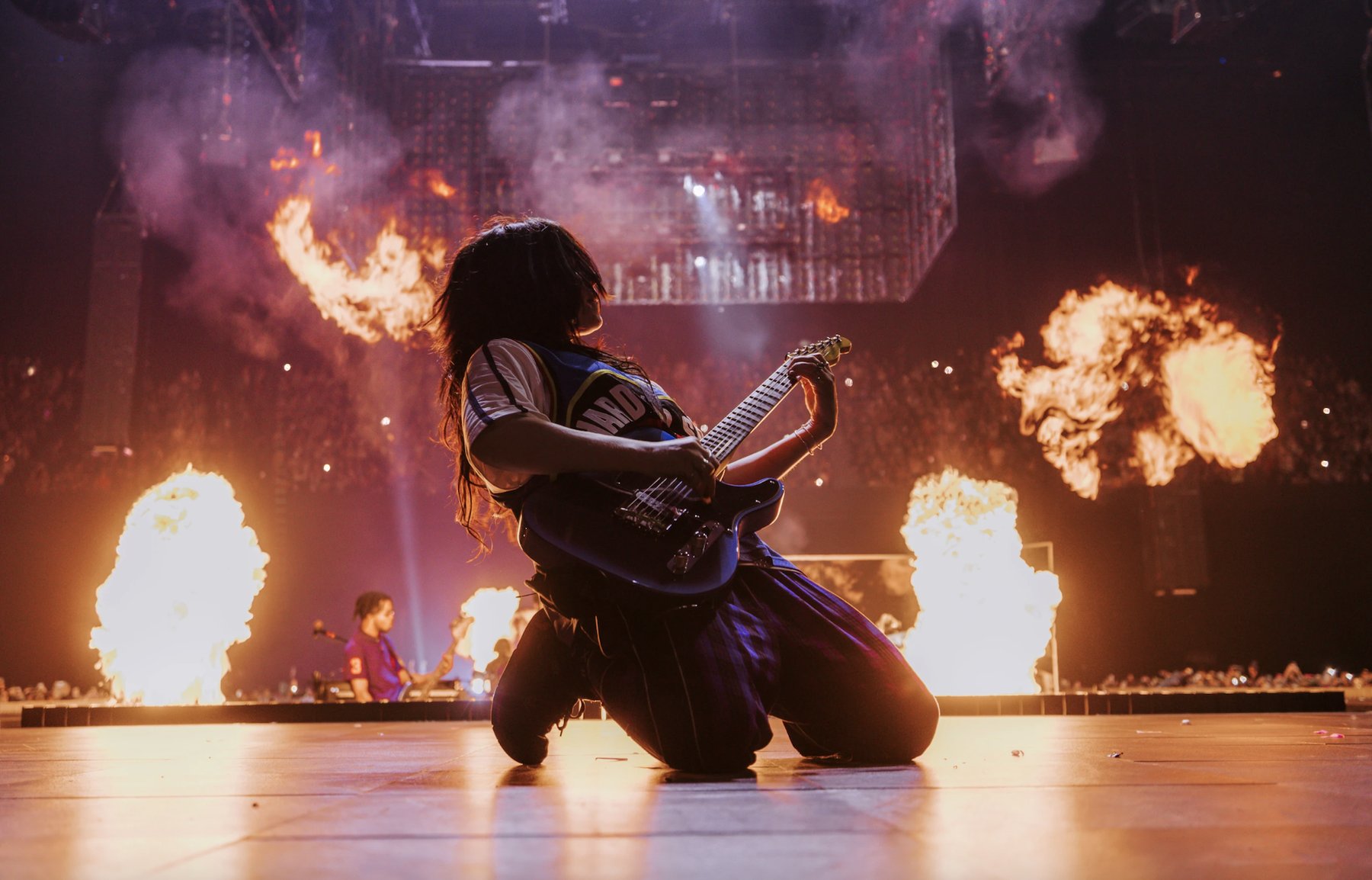
Billie Eilish: Hit Me Hard and Soft: The Tour (Live in 3D) is the most technically ambitious concert film ever shot. It's also a commercial disappointment. Both things are true, and the gap between them is the interesting story.
I went in expecting a competent stereo capture of an arena show. What Cameron and Eilish (co-directors, and yes, she gets a directing credit and earns it) and the Lightstorm Vision team delivered is closer to a master class in what live multicam 3D can look like when you have unlimited money, the world's most experienced stereo director, and a credits roll full of rotoscope artists. The variety of shot types, angles, and depth treatments is broader than anything I've previously seen in a 3D concert film. The post-conversion work is so clean I had to go back to interviews to figure out what was native stereo and what wasn't.
Here is the technical breakdown, the standout shots, and where the industry actually goes from here.
The Capture Stack
The film was shot at Eilish's four sold-out nights at Co-op Live in Manchester in July 2025. Cameron persuaded her to wear the same outfit each night so footage could intercut freely across shows. That's a standard multicam trick at this scale, but it gave him four passes to reposition rigs and chase coverage. He's been open in interviews that they choreographed each night's camera plan during soundcheck.
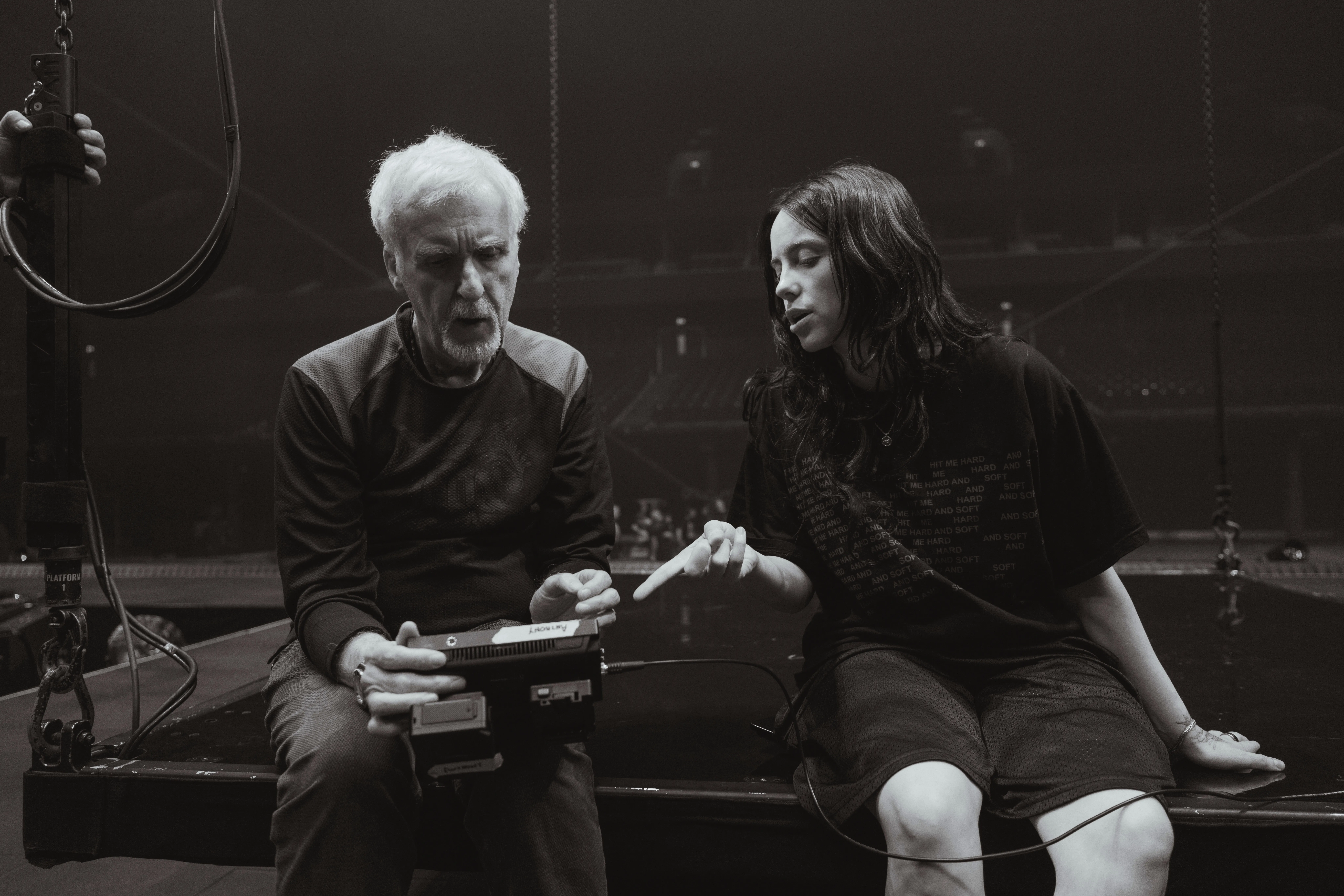
The Lightstorm Vision rig package, as Cameron described it at CinemaCon and on The Hollywood Reporter's Awards Chatter podcast, included three notable elements.
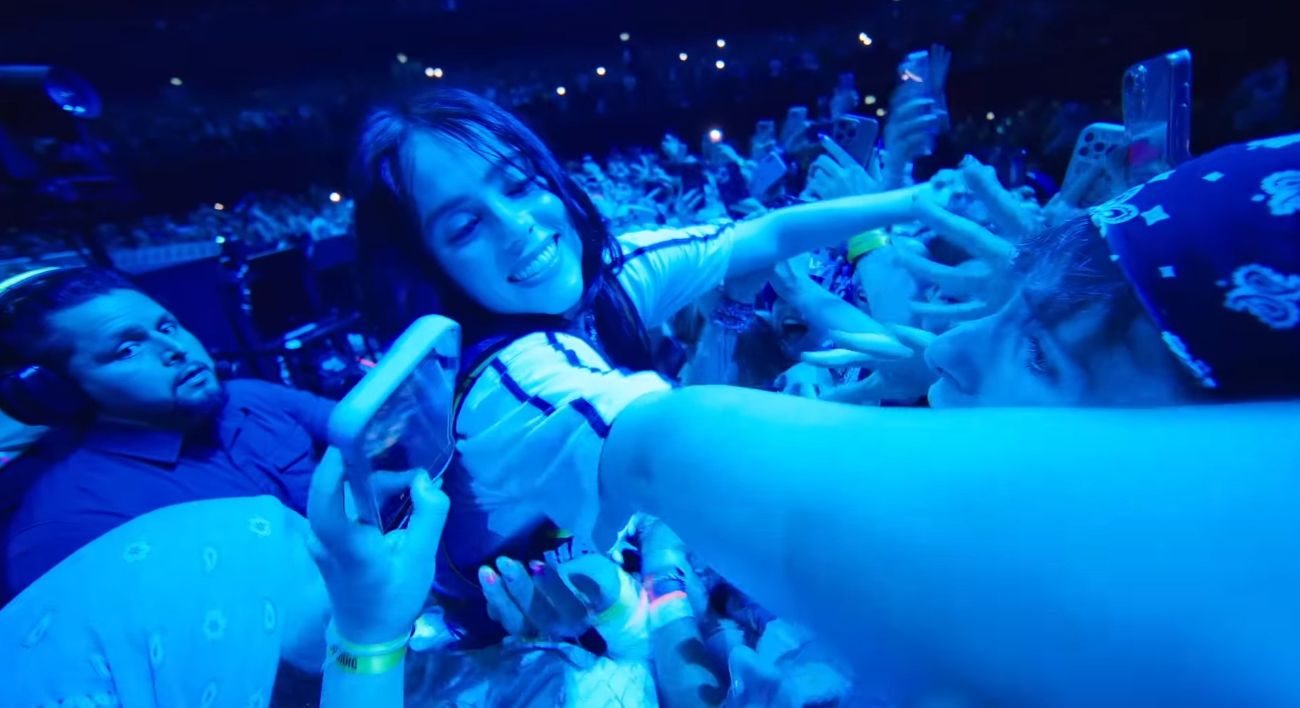
The first is a new generation of tiny native-stereo 3D camera systems, developed in-house and used on roughly a quarter of the film. Cameron specifically said these systems had not been used before, including on the Avatar films. These enabled the up-close handheld and on-stage POV work. They are also, almost certainly, what Eilish picks up and points at the crowd during several songs. If you watched that and assumed it was a mono camera converted in post, you were probably wrong. The Roger Ebert review describes her grabbing "a portable 3D camera," consistent with Cameron's tiny-rig comments.
The second is long-lens stereoscopic rigs for the tight close-ups from the back of the arena. Long-lens 3D is technically thorny because interaxial separation has to be tuned aggressively to avoid hyperstereo, the miniaturization effect where far subjects look like dollhouse figures. Getting genuinely intimate close-ups from 100 feet out with believable depth is a real accomplishment, and you can see it pay off all over the film.
The third is Steadicam and rail rigs for the stage perimeter work. The operators tracking Eilish as she runs through the pit high-fiving fans are best-in-class. I don't know if Cameron was personally operating any of them, but the framing discipline and consistent stereo convergence across moving rigs suggests his team was deeply involved.
What stands out is the coverage cleanliness. I never once saw an audience member or a stagehand block a hero shot. Across four nights of multicam capture in an arena built around an in-the-round stage, that level of clean coverage is extremely hard. It implies extensive planning per song, predetermined lanes for each rig, and aggressive use of the four-night schedule to retake any sightline that got busted.
A Depth Budget Primer
For readers unfamiliar with stereoscopic terminology: depth budget is the total usable disparity range in a 3D shot, measured in pixels of horizontal separation between the left- and right-eye images. Positive parallax (behind the screen) and negative parallax (in front of the screen) both have hard physiological limits. Push too far on either side and the viewer's eyes have to diverge or over-converge to fuse the image, which produces eye strain, headaches, and the dreaded "I can't watch 3D" reaction. Most modern stereo workflows budget around 1 to 2% of screen width as the comfortable disparity envelope, with the front half of that being where you really have to be careful.
The standard problem at a concert: you've got lasers, DMX moving lights, line arrays, and the front edge of the stage all sitting closer to the camera than your subject. If you treat them honestly in stereo, they consume the entire front half of your depth budget, which means anything further back (the singer, the crowd, the back of the venue) gets compressed into a flat plane behind the screen. The alternative is letting the foreground stuff push hard into negative parallax and creating edge violations: an object that's stereoscopically in front of the screen but gets cropped by the screen edge, which is a hard depth-cue conflict that breaks the illusion and hurts to look at.
This is the trap concert 3D has been stuck in for fifteen years. Cameron's team escaped it.
Infinite Depth Budget via Roto-Driven Post
Watch the credits and you'll see an absurd number of rotoscope artists listed. That's the tell. Cameron is not afraid to make the shot 3D in post, and more importantly, not afraid to re-stereo native captures to redistribute depth where he wants it.
In practice: speakers, monitor wedges, DMX truss-mounted lights, and the lip of the stage that would normally consume your depth budget get isolated via rotoscope, depth-shifted toward (or onto) the screen plane, and effectively released from the disparity envelope. The result is that the stuff in the foreground reads as foreground without crowding out the rest of the shot. Lasers in the upper truss don't fight with Eilish's head for negative-parallax real estate. The crowd behind her doesn't compress into a postage stamp.
That's what I mean by infinite depth budget. It's not literally infinite, since the engineering limit on viewer comfort hasn't moved. What Cameron's team has done is decouple individual elements within a shot from the global depth envelope. Each rotoscoped element gets its own depth treatment, then the composite gets re-fused. The labor is enormous (hence the rotoscope army in the credits), but it lets a concert shot have a usable depth range across all elements simultaneously rather than spending the budget on whatever happens to be closest to the lens.
Cameron also confirmed at CinemaCon that AI was used for inventive approaches to background work. That tracks with the cleanliness. Modern rotoscope workflows are heavily ML-assisted at this point (SAM-style segmentation, ML-driven matte refinement, depth-from-monocular nets for plate generation). For a 114-minute concert film with thousands of cuts, you can't roto this much by hand in finite time without ML in the loop.
Standout Technical Moments
The film opens with a build timelapse. Day-of construction of the entire stage rig in the Co-op Live arena, before the lights go down and the seats fill. The closer is a teardown timelapse during the credits. Cheap to acquire, expensive in storytelling impact, and entirely the right call for an arena documentary. The fact that we see what it takes to put this thing together and then watch it disappear gives the live performance footage a sense of weight that other concert films often miss.
A few other sequences worth calling out specifically.
The cube reveal and pull-back after the opener. After the explosive first song, the camera pulls back and out, showing the venue's scale before cutting to behind-the-scenes coverage. As a 3D storytelling beat, collapsing the intimate and then revealing the colossal, it's one of the top moments of the film. The transit through the equipment cube, with Eilish hidden inside being wheeled to her opening mark, is shot from inside the box and reads as genuinely claustrophobic in stereo. This is the kind of confined-space 3D the tiny Lightstorm rigs were built for.
The selfie-stick handheld POV. Eilish carrying a small camera around stage, pointing it at herself and the crowd, occasionally setting it on the ground and singing over it. As noted above, this is native stereo, not mono-to-3D conversion. Whether there was additional tooling on the rig (IMU data, parallel mono witness cam for post-fix, depth sensors for matte assist) Cameron hasn't said publicly. Worth digging into when the trade press post-mortems land.
The pit-run sequence. Operators with handheld 3D rigs running backwards in front of Eilish as she sprints through the audience high-fiving fans. The negative-parallax aggressiveness of the outstretched hands works because the edges have been carefully managed. Fingers don't crop hard against the screen edge in any of the shots I noticed. This is either floating-window deployment (synthetic edge brought forward to mask edge violations) or surgical roto-driven depth shifting per hand. Probably both.
The laser work. Lasers in 3D are notoriously hard. Beams have to read as volumetric without spiking past the depth budget, and the moving heads have to track without strobing the convergence. The film handles this cleanly throughout.
The screen-on-screen photography. Shooting the LED wall content through the 3D rigs produces an interesting moiré-free mixed-media effect that works because the LED content was likely depth-graded alongside the foreground.
The mandatory confetti cannons. You can't make a 3D concert film without them. They're there. They're great.
The Post Stack: Pixelworks TrueCut and HFR Handling
Pixelworks announced in mid-May that their TrueCut Motion platform handled motion grading on the film. This is worth understanding. Lightstorm Vision captured at high frame rates (Cameron's preferred capture strategy since The Way of Water), but high-frame-rate footage played back at HFR can read as "soap opera effect," that hyper-real, video-y look that breaks the cinematic spell. TrueCut Motion lets you grade the motion characteristic per shot, preserving HFR's clarity on fast pans and close-ups while keeping a more filmic look on lyrical or static moments. For a concert film where you cut between Eilish running across the stage and her sitting still during a ballad, that shot-by-shot motion grading is the right tool.
The film also has a Meta Quest VR release running in parallel through Lightstorm Vision's partnership with Meta. Same capture, different distribution stack.
The Mix

The sound design is the most underrated technical aspect of the film. The mix is dense but never harsh. The vocals sit forward without sacrificing the room sound from the venue. Subtle ambient bedding is layered throughout the live performance segments. The one creative misstep, in my view, is the use of music beds under the documentary interview segments. They flatten what should be intimate one-on-one conversations and lean into a more conventional concert-doc feel that the rest of the film actively avoids. The interview material itself is the weakest content in the film regardless, although it does make clear how completely Eilish drives the creative vision of the tour and this film.
The Economics, and Why This Matters
Verified production budget: $20 million (IndieWire, Insight Trends World, and multiple trade sources confirm). As of May 17, 2026, the film has grossed roughly $9.7M domestic and $25.6M worldwide, with a $7.0M domestic / $20.1M worldwide opening weekend. That was the best concert film opening in three years and the third-best domestic concert opening of the decade behind Taylor Swift's Eras Tour and Beyoncé's Renaissance. The film also finished fifth for its opening weekend, behind a $16M-opening original called The Sheep Detectives, which is the kind of detail that makes the soft-for-Cameron framing land. It's not a runaway hit, and it's notably soft against the Cameron co-direction premium. The best historical comp is Katy Perry: Part of Me (2012): $7.1M opening, $32.7M final worldwide — a film I happened to work on through AEG, on some of the live capture components, so consider that comp delivered with skin in the game. If the Eilish film follows that curve, it lands somewhere around $40M worldwide.
At a 9x box office to production multiplier for a concert doc to be considered a clear win, this needed to do roughly $180M worldwide. It will not.
The Cameron technical achievement here is the most important data point. He proved you can do native multicam stereo at concert scale, deploy a roto+AI pipeline to manage depth budget per element, motion-grade HFR capture shot-by-shot, and release in PLF and Quest VR simultaneously. The artistic ceiling for the format is much higher than anyone had demonstrated. The commercial result tells you the prestige-director attachment does not change the economics. The audience for a concert film is fundamentally the artist's fanbase, and Cameron's name doesn't expand that.
What Comes Next
Cameron has now established the upper technical bound. The interesting question is what happens when that capability becomes affordable.
Live multicam 3D capture in a roughly $50K rig package is plausible within the next 12 to 18 months. That's a space my company is building into. Add a post-conversion pipeline that leans on ML-assisted roto (which is the only way the Lightstorm work scales economically anyway) and you can deliver a 3D concert film into premium-format theatrical for under $1M end-to-end, including post and marketing. At that production cost, the Eilish film's $25M worldwide would be a major win, not a disappointment.
The Cameron film is the ceiling. The opportunity is in the floor. Hit Me Hard and Soft is what concert 3D can look like when nothing about the budget constrains you. Now the question is what it looks like when everything about the budget does, and whether the audience can tell the difference.
Sources: The Hollywood Reporter's Awards Chatter podcast (January 2026), CinemaCon 2026 Paramount presentation, Pixelworks press release (May 14, 2026), IndieWire box office reporting, Roger Ebert and LA Youth reviews, Wikipedia.
Follow the Front Row
Immersive concerts, behind-the-scenes, and spatial video — don't miss what's next.
No thanks, maybe later